
Tracing History and Passion: A Journey into the Memory of Music
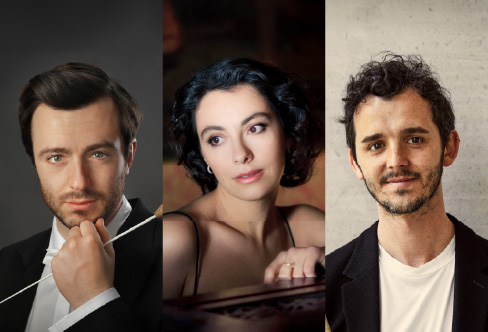
In conversation with conductor Martijn Dendievel, pianist Maria Meerovitch and trumpeter Omar Tomasoni, we explore the historical layers of music, the limits of interpretation and the dramatic language of the stage.
To follow the traces of history is not simply to preserve the past, but to hear and understand it anew through the sensibilities of the present. Three distinguished performers share how this perspective shapes their own artistic practices, revealing the hidden layers within music’s memory. From the foundations of conducting to the physical and psychological dimensions of performance, from the instrument as a dramatic voice to reflections for young musicians, the conversation opens onto a wide and engaging range of ideas.
Martijn Dendievel – Conductor
How would you define “Tracing History”? Is its purpose to conserve the past, or to reframe it in light of present perspectives?
To me, “interpretation” has never been to merely present my own view of the work, but to search for the context in which the composer wrote the piece, for which orchestra (including: for which instruments!), for which audience, etc… Then putting this into balance with the orchestras, audiences and halls we perform for/in, which might lead to decisions to, for example, alter articulation, dynamics, etc. Profound study and deep respect for the composer and composition technique is invaluable to achieve this goal. And of course, you need to take into account the traditions and particularities of each orchestra, which are connected to their countries’ traditions. Tracing history is therefore not a goal, but a mean in the preparation for a performance.
Growing up in a musical family and encountering various instruments at an early stage of your life, how do those formative experiences continue to shape your artistic perspective as a conductor?
Perhaps the biggest influence was that music was always around somehow. Either I, or one of my brothers would be practising, or my mother would, as she is a professional pianist and violinist. Or there would be students of hers at our home. So naturally, there was always music at home and that definitely influenced my choice to become a professional musician myself. Together with my four brothers (I’m the eldest of five), we also often played music together and would form our own little orchestra. Learning to listen to each other was an important factor in this, and I try to listen very closely whilst conducting as well.
Maria Meerovitch – Piano
In your engagement with music, what do you find yourself tracing most closely: the composer, the historical context, or the emotional landscape of the work?
I guess, everything begins with the composer. Not only with his ideas or state of mind, but with the time in which he lived — the events unfolding around him, the nature he contemplated, the atmosphere that shaped his inner world. All of this breathes quietly between the lines of the score.
As performers, our task is to become a bridge between that world and the listener. We are entrusted with carrying the composer’s message to the public. I strive to remain as faithful as possible to the written text.
And yet, music comes alive only when it passes through a living soul. I speak the composer’s language, but with my own voice — allowing my emotions, experiences, and reflections to merge with the landscape of his work. In this meeting between past and present, between his truth and mine, the music finds its breath.
Through your work on performance-related injuries and stage fright, you have explored the physical and psychological dimensions of musicianship. How has this inquiry transformed your own artistic practice?
As Luciano Pavarotti once said, “Don’t believe artists who claim they are not nervous before going on stage.” I don’t believe it either.
Stage nerves are real — they are part of caring deeply about what we do. But there is an important difference between being nervous and being excited.
Through my research and preparation, I have learned to transform that fragile energy into something constructive. Instead of allowing anxiety to take over in the moment of performance, I try to channel it into focus, presence, and intention.
This shift creates space — space for excitement, for freedom, for spontaneity. And in that space, the performance becomes not a test to survive, but a living, breathing dialogue with the audience.
Omar Tomasoni – Trumpet
If we imagine the trumpet line in Shostakovich as a character, how would you describe its role and identity within the drama of the performance?
The character of Shostakovich’s trumpet part is powerful at the end of the piece and sweet, elegant and caricaturist during the other movements… it start as an accompanist and slowly takes over and became co-protagonist.
If you were to offer one piece of advice to a young trumpeter at the beginning of their journey, what would it be?
To the new trumpet player’s generation I would tell to find there own sound and identity.. to make their personal music choices and to find their uniqueness.
Share on


